
 22 June 2026
Drip Irrigation in Greenhouse Tunnels
Drip Irrigation in Greenhouse Tunnels: A Practical Guide for Better Water Management
By Dicla Horticulture
Water is one of the most important inputs in any farming operation. In greenhouse tunnel production, it becomes even more important because crops are grown in a more controlled and intensive environment. When water is applied correctly, plants can grow more evenly, nutrients can be delivered more accurately, and the grower has better control over crop quality and production planning.
This is where drip irrigation becomes one of the most practical solutions for tunnel farmers.
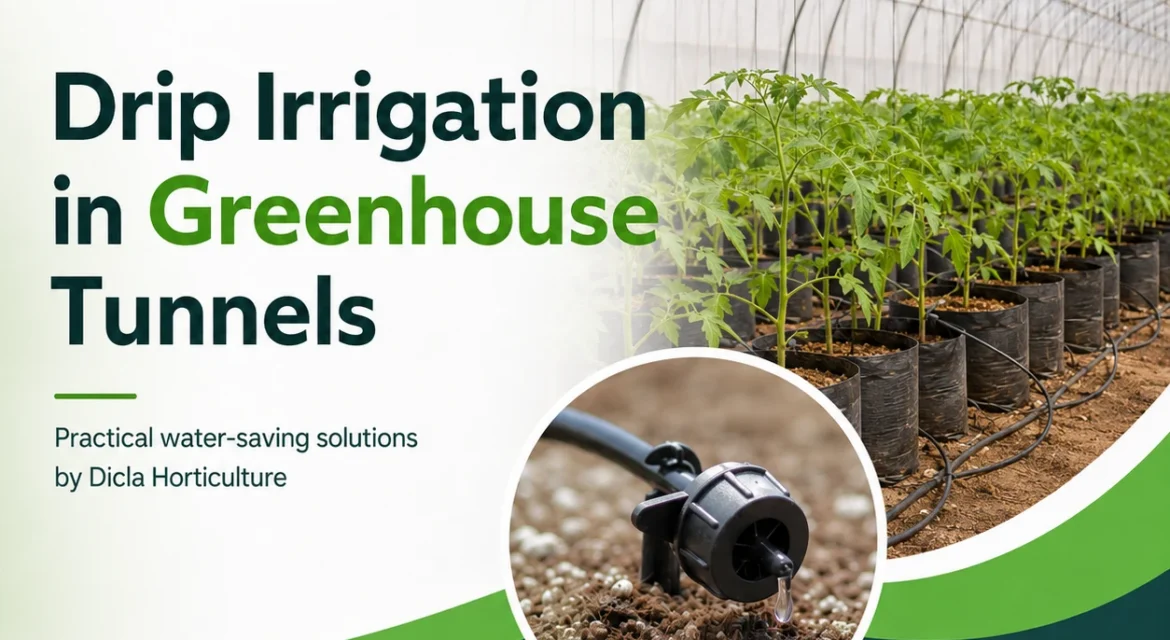
Drip irrigation is designed to deliver water directly to the plant root zone, instead of wetting large areas of soil unnecessarily. In a greenhouse tunnel, this approach can help reduce water waste, improve crop consistency, and support better use of fertilisers through fertigation.
For vegetable production, seedling production, grow bags, and tunnel crops, drip irrigation is not only about watering plants. It is about creating a more efficient growing system.
Why drip irrigation works well in greenhouse tunnels
In open-field farming, weather plays a major role in water loss. Wind, heat, and direct sunlight can increase evaporation and make irrigation less predictable. Inside a greenhouse tunnel, the environment is more protected, but water still needs to be managed carefully.
Drip irrigation helps growers apply water where it is needed most. Instead of soaking the entire growing area, water is delivered close to each plant. This supports more uniform growth and helps prevent parts of the tunnel from becoming too wet while other sections remain too dry.
For tunnel farmers, this can help with:
- More accurate water delivery
- Better moisture control around the root zone
- Reduced water wastage
- Improved fertiliser application
- More consistent crop development
- Lower risk of unnecessary wet foliage
- Better planning during hot or dry periods
In crops such as tomatoes, cucumbers, peppers, herbs, and leafy vegetables, consistent moisture management can make a major difference to crop quality. When plants receive water too irregularly, the result may be uneven growth, stress, poor fruit quality, or lower production.
Drip irrigation is also about fertigation
One of the biggest advantages of drip irrigation in greenhouse tunnels is the ability to combine irrigation with fertiliser application. This is commonly known as fertigation.
With a well-designed fertigation system, nutrients can be applied in smaller, more regular amounts. This supports the plant during key growth stages and can reduce the risk of over- or under-feeding.
However, fertigation must be managed carefully. Fertilisers need to be compatible with the water source, the irrigation system, and the crop programme. Poorly managed fertigation can cause nutrient imbalances, salt build-up, or blocked emitters.
For this reason, Dicla Horticulture recommends that growers plan the full irrigation system properly before installation. This includes water source, filtration, pressure, dripline layout, flushing points, and the type of fertiliser programme to be used.
The problem many farmers overlook: blocked drippers
A drip irrigation system is only as good as its flow. If the drippers or nozzles start to clog, the system becomes uneven. Some plants may receive enough water while others receive too little. In a greenhouse tunnel, this can quickly lead to uneven growth and production losses.
Blocked drippers are usually caused by one or more of the following:
- Sand, soil, or fine particles in the water
- Algae or organic material from dams or tanks
- Mineral deposits such as calcium, iron, or manganese
- Fertiliser deposits caused by poor mixing or incompatibility
- Biofilm or bacterial build-up inside pipes
- Poor flushing and maintenance
- Incorrect filter selection
Many farmers only notice the problem once plants begin showing stress. By then, the crop may already have lost valuable growth time.
A proper filtration system is therefore not an optional extra. It is one of the most important parts of a reliable drip irrigation system.
Why filter systems are essential
Because drip irrigation emitters have very small openings, even fine particles can eventually cause blockages. A filter system helps protect the drippers, laterals, valves, and fertigation equipment.
The correct filter depends on the water source.
For example, water from a borehole may contain fine sand or minerals. Water from a dam, river, or storage tank may contain algae, organic matter, or sediment. Municipal or stored water may still require filtration depending on the quality and the irrigation layout.
Common practical filter options include:
- Screen filters for general particle removal
- Disc filters for finer filtration and improved cleaning capacity
- Sand media filters for water with more organic matter
- Combination systems where water quality requires more protection
In many greenhouse tunnel systems, a properly sized disc or screen filter is a practical starting point. However, if the water source contains heavy organic material, algae, or high sediment levels, a more complete filtration setup may be needed.
A filter should also be easy to access, clean, and monitor. If a filter is too small, poorly installed, or ignored, pressure can drop and irrigation uniformity can suffer.
Practical solutions for greenhouse tunnel irrigation
A good drip irrigation system starts with proper planning. The following areas should be considered before installation:
1. Test the water source
Before installing or upgrading a system, the water source should be assessed. This helps identify potential clogging risks such as sediment, iron, calcium, algae, or high pH.
Knowing the water quality helps determine which filter system is needed and whether any additional treatment or management is required.
2. Use the correct filter system
The filter should be matched to the water source, the dripline, and the crop system. The goal is to prevent particles and deposits from reaching the drippers.
Farmers should also clean filters regularly and check pressure before and after the filter to identify blockages early.
3. Install flushing points
Every drip irrigation system should allow for flushing. Fine particles can settle inside pipes and laterals over time, even when filters are used.
Flushing points at the end of lines make it easier to remove sediment before it causes problems.
4. Manage pressure correctly
Drip irrigation systems need the correct pressure to work evenly. Too little pressure can reduce flow. Too much pressure can damage fittings or cause uneven application.
Pressure regulation is especially important in longer tunnels, sloped sites, or systems with multiple blocks.
5. Divide the tunnel into irrigation zones
Not all crops, rows, or tunnel sections need the same amount of water at the same time. Dividing the system into zones helps the grower manage irrigation more accurately.
This is useful when tunnels contain different crops, different growth stages, or different planting densities.
6. Plan fertigation carefully
Fertilisers must be mixed and applied correctly. Some products can react with minerals in the water or with other fertilisers, causing deposits that block lines and emitters.
A clean fertigation setup, proper mixing practice, and regular flushing can help reduce these risks.
7. Inspect the system regularly
A drip irrigation system should not be installed and forgotten. Regular checks are essential.
Farmers should inspect:
- Filter cleanliness
- Pressure levels
- Dripper flow
- Wetting patterns
- Leaks
- Blocked or damaged lines
- Crop uniformity
- End-line flushing points
Small problems are much easier to fix before they become crop problems.
8. Match irrigation to crop stage and growing media
A young seedling does not need the same amount of water as a mature fruiting plant. A crop grown in soil also behaves differently from a crop grown in bags or soilless media.
Irrigation scheduling should consider crop stage, root development, temperature, tunnel ventilation, growing media, and drainage.
Drip irrigation in bags, tunnels, and open fields
Dicla Horticulture works with growers across different production systems, including greenhouse tunnels, shade houses, planting bags, seedling production, and open-field vegetable farming.
Drip irrigation can be adapted to each of these systems, but the design must suit the crop and the growing method.
For planting bags, the number of drippers per bag, the flow rate, and the irrigation frequency are important. For in-ground tunnel crops, row spacing, soil type, and root depth must be considered. For open-field systems, slope, pressure, and longer pipe runs become more important.
There is no single irrigation layout that suits every farm. The most practical solution is one that is designed around the grower’s crop, water source, tunnel structure, and production goals.
Better irrigation means better control
A greenhouse tunnel already gives farmers more control over the growing environment. Drip irrigation adds another layer of control by improving how water and nutrients are delivered.
When planned properly, a drip irrigation system can help farmers reduce waste, improve crop uniformity, and protect their investment.
But the key is design and maintenance. Filters, pressure control, flushing points, water quality checks, and practical system management all matter.
A blocked dripper may look like a small problem, but across a tunnel, small blockages can become uneven crops, lower yields, and lost production.
Talk to Dicla Horticulture
Dicla Horticulture supplies practical solutions for tunnel farming, vegetable production, crop support, irrigation, planting bags, grow media, and protected agriculture.
Whether you are building a new greenhouse tunnel, improving an existing setup, or planning a better irrigation system, our team can help you choose a practical solution for South African farming conditions.
Think growth. Think Dicla.
Call: 011 662 2846
Email: horticulture@dicla.com
Website: https://horticulture.dicla.com